
ABOUT Gerard Chambers
About Gerard Chambers
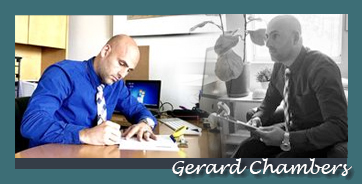
I’m a specialist in difficult cases. When the diagnosis is uncertain, when previous answers conflict, and when objective evidence matters — that’s the work.
Gerard Chambers, Psy.D., Ph.D. — California Licensed Psychologist, PSY #23778. I assess children, adolescents, and adults with neurodevelopmental and neurocognitive disorders, and I’ve spent a large part of my clinical career evaluating children and adolescents with significant behavioral issues in both inpatient and outpatient forensic settings.
Where the method came from
I trained under Dr. Charles Stevens, a behavioral psychologist and autism specialist — the psychologist who worked with the original “Rain Man,” the case that became the 1988 film about the autistic savant.
Stevens completed much of his own training under Joseph Wolpe, M.D., one of the founders of behavior therapy. That lineage shaped how Stevens trained me, and it’s why this practice looks the way it does: measure the behavior, rule out the alternatives, and let the evidence say what it says.
During my training I was responsible for neuropsychological evaluations of people needing diagnosis for autism spectrum disorders and other neurodevelopmental disabilities.
Re-specialization in neuropsychology
After licensure as a psychologist, I completed a formal re-specialization in clinical neuropsychology: two years of didactic training at Palo Alto University in accordance with Houston Conference Guidelines, and two years of postdoctoral neuropsychological supervision with Neuropsychological Associates in Santa Rosa, and at Fairmont and Highland Public Hospital, part of Alameda Health Systems.
Full curriculum vitae, including testimony and deposition history.
Forensic work
I’ve served as a court-appointed neutral evaluator and as a retained expert for plaintiffs, defendants, and agencies in the California Superior Court system — including Evidence Code §730 appointments in Santa Cruz, Santa Clara, Sonoma, San Mateo, and Alameda Counties.
I appeared as a guest forensic expert on LMN’s Killer Kids in 2013.
More on forensic evaluation and expert testimony.
I explain things for a living
This is the part of the record that matters most to a patient, and it’s the part that usually gets left off.
I lectured nationally on EPPP licensure preparation — abnormal psychology, clinical psychology, learning theory, test strategy, and ethics — in cities including Boston and New York City, and Chicago. Hundreds of applicants across the United States and Canada sat in those rooms.
I’ve been adjunct faculty at Eastern Florida State College since 2004 — abnormal psychology, human adjustment, developmental psychology, general psychology. On campus, hybrid, and online.
I lecture and provide Continuing Legal Education units to attorneys in Santa Clara and Santa Cruz Counties, on assessment and brain-based topics.
“Teaching is something that I love to do. I was blessed with some of the most caring and talented teachers anyone could have asked for, and now it’s my turn to give back.”
That’s not a hobby that sits next to the clinical work. It’s why an evaluation here comes with an explanation you can actually use — one you can hand to a physician, a school, or a court, and one you can understand yourself.
Fort Drum
After my postdoctoral hours, I served as a consultant to the 1-87 Light Infantry at Fort Drum, New York — one of the most heavily deployed units in the United States Army.
I delivered resiliency training to over a thousand soldiers and their families and received two commendations for it, along with three coins for excellence and a plaque commemorating the time with the unit.
“I have never before in my life witnessed such hard work and sacrifice as our servicemen, servicewomen, and their families put forth on a daily basis. Each and every one of them is a shining symbol of freedom — here, and throughout the entire world.”
It remains one of the most fulfilling and honored tasks of my career.
What this adds up to
Behavioral training from a lineage that goes back to the founding of behavior therapy. Neuropsychological re-specialization after licensure, because the questions I was being asked required it. Twenty years of forensic work where every opinion has to survive someone whose job is to break it. And two decades of explaining psychology to people who had to pass a test on it.
Good neuropsychology is not about confirming what someone already believes. It’s about asking the right question, considering competing explanations, ruling out the alternatives, and letting the evidence determine the conclusion.
Complexity deserves careful thinking. That’s the whole method.
Start here
Call. 321-208-1554 or 321-298-8668
1120 McKendrie Street, San Jose. Tell us the question you’re trying to answer. If I’m not the right person, I’ll tell you that and point you toward someone who is.